Menu
FOLLOW ON
RESINS
Understanding Mechanical Properties in Articulated Sculptures

Copyright © 2022- huli.dolls
-What Technical Datasheets Don’t Tell Us
-The Myth of the Magic Formula
-A Final Thought on Marketing Claims and Material Superiority
-A Little Real-World Experiment
AI Training & Content Use
All original artwork, sculptures, designs, images and written content published on this website are protected by copyright. I do not consent to the use of any content from this website for training, developing, fine-tuning or evaluating artificial intelligence systems, including generative AI models. No permission is granted for automated scraping, extraction, reproduction or inclusion of my work in AI training datasets without my prior explicit written authorisation.
© Hulidolls All rights reserved.
First things first: this is not a debate about cast polyurethane versus 3D-printed resin. Nor is it a competition between different 3D-printing resins to determine which one deserves the crown.
I’m not interested in declaring a universal winner, because there isn’t one.
Every material has its strengths, limitations and trade-offs. What makes one suitable for a particular application may make it less suitable for another. So, rather than asking “Which resin is the best?”, I think a much more useful question is: “What do I actually need this material to do?”
I started working with 3D printing back in 2017. Over all these years, I haven’t simply looked at what other sculptors were doing and followed their choices. I’ve made a point of understanding why certain materials and mechanical solutions work, where their limitations lie, and how they behave under different conditions. My objective has always been to make informed choices for my sculptures, rather than adopting a material simply because it is popular or widely used. And that brings us to the purpose of this article. If you’ve ever looked at a resin’s technical datasheet, you’ve probably encountered terms such as tensile strength, elongation at break, Shore D hardness or Young’s modulus. But what do those numbers actually mean? And, more importantly, what can they tell us about a ball-jointed sculpture? Let’s find out.
I’ve deliberately omitted brand names and product codes from the comparison. That’s intentional. The table includes three different formulations from one 3D-printing resin manufacturer and two different formulations from one polyurethane casting resin manufacturer. Even within the same brand, different formulations can have significantly different mechanical properties. And, of course, these differences also exist between manufacturers. This is precisely why we cannot assume that all 3D-printing resins, or all polyurethane casting resins, behave alike. I’m not sponsored by any manufacturer, nor do I have any commercial incentive to promote or recommend a particular product. The figures presented are based on publicly available manufacturer specifications and serve only to illustrate the mechanical characteristics I consider when selecting materials. They are not intended as a definitive performance ranking, especially where testing conditions differ. My intention is to explain the reasoning behind my choices, not to turn this into a product advertisement.
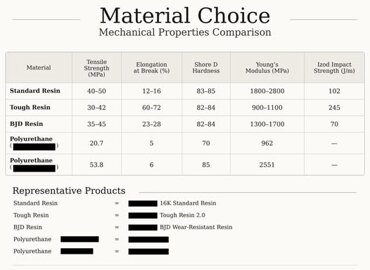
Manufacturer-reported mechanical properties. Values may have been obtained using different testing conditions and should be regarded as illustrative reference data rather than directly comparable performance rankings. A dash indicates that the manufacturer did not report the property.
1. Tensile Strength (MPa)
How much pulling stress can a material withstand?
Tensile strength measures the maximum stress a material can withstand during a standardized pulling test.
In a BJD, the internal elastic stringing system creates forces throughout the structure. Depending on the geometry, these can produce tension, compression and bending, particularly around stringing channels, joint sockets and thinner sections. Higher tensile strength generally indicates better resistance to pulling stress under comparable conditions. But here’s an important distinction: strong doesn’t necessarily mean tough. A material can withstand considerable tensile stress and still fracture abruptly when bent or struck. Tensile strength tells us something useful about resistance to pulling loads, but it cannot tell us whether a resin will survive a fall or how its joints will perform over time.
2. Elongation at Break (%)
How much can a material stretch before breaking?
Elongation at break measures the percentage increase in length a specimen undergoes before fracturing during a tensile test. For example, a specimen with 10% elongation at break can extend by approximately 10% of its original gauge length before failure under the specified testing conditions.
Why does this matter for BJDs? Think about delicate fingers, ears or thin joint edges. These features may experience accidental bending during handling or falls. A material with greater elongation at break may tolerate more deformation before fracturing. However, this doesn’t automatically mean it will survive repeated bending or resist cracks better. Those behaviours depend on additional properties and testing conditions. Flexibility, strength and resistance to fracture are related, but they are not interchangeable.
3. Young’s Modulus (MPa)
How stiff is the material?
Young’s modulus measures resistance to elastic deformation under uniaxial loading. A higher value indicates greater stiffness, while a lower value means the material deforms more easily under comparable stress.
For articulated sculptures, stiffness helps structural components maintain their geometry under load. Joint sockets, connecting elements and thin walls must be sufficiently rigid to preserve their intended shape and alignment. But is the stiffest resin automatically the best choice? Not necessarily. A very stiff material may resist deformation effectively while offering limited tolerance to certain stresses before fracture. And a more flexible material may absorb deformation without necessarily providing the structural stability a particular component requires. The objective is to achieve the appropriate stiffness for the design, not simply the highest number.
4. Shore D Hardness
How resistant is the surface to indentation?
Shore D hardness measures a material’s resistance to indentation using a standardized durometer test.
This matters for BJDs because articulated surfaces experience localized contact pressure, particularly where joint balls meet their sockets. Higher hardness generally indicates greater resistance to indentation under comparable test conditions. But does a harder resin automatically produce better joints? No. Hardness is not the same as wear resistance. It doesn’t directly tell us how quickly two surfaces will deteriorate through repeated friction, nor does it establish whether a material is brittle. Joint performance also depends on surface finish, contact geometry, applied forces and the materials interacting with each other.
5. Izod Impact Strength (J/m)
How does a material respond to a sudden impact?
The Izod impact test measures the energy absorbed by a standardized specimen subjected to a sudden pendulum strike. Results expressed in J/m are normalized according to the applicable test method.
For a BJD, this is relevant to accidental knocks, falls and impacts that may damage delicate features or structural components. Higher values generally indicate greater energy absorption under comparable testing conditions. However, there’s a catch. Izod results depend on factors such as specimen geometry, temperature and whether the sample is notched or unnotched. Values obtained through different testing methods cannot automatically be compared. And while impact strength gives us useful information about behaviour under sudden loading, it doesn’t predict long-term wear, repeated posing or resistance to an existing crack spreading. Surviving an impact and surviving years of articulation are two different mechanical challenges.
Why These Properties Matter
Which one is better for a BJD? There isn’t enough information to decide. Material A might be suitable for a component requiring high stiffness and dimensional stability. Material B might offer advantages for a delicate feature exposed to accidental bending. Even within the same sculpture, different components may benefit from different mechanical characteristics. And material properties are only part of the equation. Wall thickness, joint geometry, stress concentrations, stringing tension and assembly methods can substantially influence performance. A poorly designed component made from an otherwise strong resin can fail where a better-designed component made from a less impressive material succeeds.
This is precisely why I consider the relationship between material properties and mechanical design more meaningful than ranking resins by a single specification.
What Technical Datasheets Don’t Tell Us
Manufacturer specifications are useful, but they have limitations. The published figures describe materials tested under particular laboratory conditions. They don’t necessarily represent how those materials will perform in a finished articulated sculpture. For 3D-printed components, printing orientation, exposure settings, post-curing and processing conditions can influence mechanical behaviour. The same applies when working with custom resin mixtures or additional colourants. Material ageing, sustained loading, environmental exposure and repeated joint friction cannot be reliably predicted from these five values alone.
WHY I CHOOSE TOUGH RESINS
My preference comes from the mechanical behaviour I prioritise in my articulated sculptures.
A BJD is not simply a static object. Its components are subjected to elastic tension, repeated movement, friction, occasional impacts and stresses concentrated around joints, sockets and thinner anatomical features. This is where certain tough resin formulations offer advantages that I consider particularly valuable. One of their most useful characteristics is their ability to undergo greater deformation before breaking. Higher elongation at break, combined with appropriate impact resistance and fracture toughness, can make a significant difference in delicate components such as fingers, ears, thin edges and areas surrounding joint openings. Instead of fracturing under bending or sudden impact, a suitably formulated material may accommodate deformation and absorb some of the mechanical energy involved. And for me, that’s an important advantage.
But flexibility alone is not enough. An articulated sculpture must also maintain its geometry. Joint sockets need sufficient stiffness, contact surfaces must remain functional, and components subjected to constant elastic tension should resist progressive deformation. The challenge is finding a balance between damage tolerance and structural stability.
This is also why I don’t consider surface hardness or tensile strength, taken individually, sufficient indicators of a resin’s suitability for BJDs. A harder material is not necessarily more resistant to impact.
A stronger material in a tensile test is not necessarily more resistant to cracking. And neither property, on its own, tells us how a joint will behave after repeated movement.
My choice also reflects the way I design my sculptures. I can digitally control wall thickness, reinforce mechanically sensitive areas, adjust internal geometry and reduce unnecessary mass where needed. This allows me to combine material selection with structural decisions rather than expecting the resin alone to compensate for every weakness in the design. Ultimately, I prefer a material that offers sufficient rigidity while allowing a greater margin for deformation and impact tolerance, particularly in vulnerable areas. That doesn’t mean my sculptures are unbreakable. No resin can guarantee that.
It means that, for the mechanical behaviour I want from my work, the tough formulations I have selected offer a balance of properties that suits my priorities.
I don’t choose a resin based on which label happens to be winning the latest marketing battle.
I choose it because of what the material can actually do.
THE MYTH OF A THE MAGIC FORMULA
Every now and then, someone comes along claiming to have developed a special resin blend, promising exceptional properties based on their personal experience. There is nothing wrong with experimenting or developing custom mixtures.
However, tensile strength, elongation at break, impact resistance, hardness and stiffness are measurable properties, not matters of personal opinion.
The mechanical properties of a resin blend cannot simply be assumed from those of its individual components. The final formulation, including any added colourants or other additives, must be evaluated as a whole. Personal experience cannot, on its own, establish how a material’s mechanical performance compares with alternatives.
Secret formulas are not technical specifications. Ultimately, anyone wishing to make an objective comparison between different materials should support their conclusions with documented measurements, relevant technical data and comparable testing conditions, rather than presenting personal impressions as established facts.
This is also why the resin I use has never been a secret. Quite the opposite. I openly identify my materials so that their published technical specifications can be consulted and evaluated independently. For the same reason, I do not add colourants to my resin. Doing so would introduce another variable whose effects on the final mechanical properties I cannot quantify without further testing.
I prefer to work with a material whose documented properties I can refer to, rather than claim performance characteristics for a modified formulation that I have not measured.
And let’s be practical. I am a sculptor, not a resin manufacturer. Why would I commission laboratory testing of a proprietary mixture when I can select an existing material with published technical specifications that meet my requirements? That is also why you have never heard me claiming that my resin is mechanically superior to someone else’s. I have no need to defend my choice against claims about supposedly exceptional formulas. The specifications are public. Anyone can examine them.
Final Thoughts
A BJD is not simply a sculpture made from resin. It is an articulated structure in which materials, geometry and mechanical forces interact. Choosing a material therefore involves more than comparing which one is strongest, hardest or most flexible. It requires understanding what each property measures, recognizing its limitations and considering how those characteristics relate to the design. After years of working with 3D printing and developing my own articulated sculptures, this remains the principle guiding my material choices: I don’t choose a material because it is considered the best.
I choose it because I understand what I need it to do, and I evaluate whether its properties are suitable for that purpose.
And ultimately, that’s what informed material selection is about.
A Final Thought on Marketing Claims and Material Superiority
I hope this article also explains why I’ve never been particularly interested in the endless debates about cast polyurethane being supposedly superior to 3D-printed resin, or in the occasional wars between different 3D-printing resins. Sadly, within the BJD hobby, marketing claims, personal preferences and convenience are sometimes presented as technical facts. One material is promoted as superior by dismissing another, while sponsored recommendations can turn into arguments about which resin everyone should be using. There’s nothing inherently wrong with recommending a product …the problem begins when commercial interests or individual experiences are used to support sweeping claims of superiority without sufficient evidence.
Casting is a manufacturing process, not a mechanical property. So is 3D printing. Neither determines the quality or durability of a finished sculpture on its own. Likewise, two resins produced using the same technology may have substantially different mechanical characteristics. This is why I’ve never considered hearsay, popularity or personal preferences sufficient grounds for choosing my materials. I would rather understand the properties, the mechanics and the limitations involved, then make informed decisions based on what my sculptures actually require. For me, the question has never been which material deserves to be called superior, but which material is suitable for the job, and why.
On a Funny Note : A Little Real-World Experiment
(and a Shipping Reality Check)
When I started to use tough resins, I decided to put two of my own dolls to a rather unconventional test: I threw them off my first-floor balcony. They landed without a single scratch. Now, before anyone gets too excited, these were not standardized laboratory tests, and successful landings certainly don’t make a material indestructible. Impact angle, landing surface and the way forces are distributed all matter.
A successful individual test is not a guarantee of identical results under different impact conditions. It is, however, a useful observation of how that particular combination of material, structural design and assembly behaved in practice.
But here’s the funny part.
Another doll, made from the same design and resin, managed to arrive at its destination broken after shipping. So, what does that tell us? Not that the technical datasheets are wrong, or that one material is necessarily better than another. Simply that real-world outcomes depend on more than material properties alone.
And apparently,
no technical datasheet can fully prepare a sculpture for the mysterious forces of parcel handling.
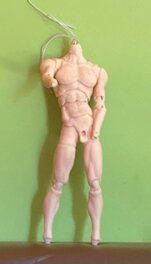
Meanwhile, my dolls are literally flying off balconies…
Not a scratch, Just a little dirt!
And there’s always someone, somewhere, going:
“Well, in my opinion, 3D-printed resins suck.” 😂
Pilot: alive and well. ✅
Structural damage: none. ✅
Scratches: zero. ✅
Landing gear: intact. ✅
Dirt: a little. 😂