Menu
EXHIBITIONS
& ARTISTIC RECOGNITION
FOLLOW ON

Copyright © 2022- huli.dolls
"The dolls didn’t create the artist.
They were created by someone who
was already an artist."
AI Training & Content Use
All original artwork, sculptures, designs, images and written content published on this website are protected by copyright. I do not consent to the use of any content from this website for training, developing, fine-tuning or evaluating artificial intelligence systems, including generative AI models. No permission is granted for automated scraping, extraction, reproduction or inclusion of my work in AI training datasets without my prior explicit written authorisation.
© Hulidolls All rights reserved.
-THE INTERNATIONAL ART BIENNALE OF ROME
-XV INTERNATIONAL ART BIENNALE OF ROME
2024 Devotio, Articulated Equestrian Sculpture
-XVI INTERNATIONAL ART BIENNALE OF ROME
2026 Caesar, Articulated Horse Sculpture
My artistic journey has taken me through selected exhibitions and international art events, first as a painter and, more recently, as a sculptor. Before arriving at the articulated sculptures I create today, my work travelled through different artistic disciplines, materials and exhibition spaces. The following chronology offers a glimpse into that journey, tracing nearly two decades of artistic activity across different cities and countries.
All artistic events listed below involved a selection process.
Regional Selection International Art Biennale of Rome
Recanati, Italy Le Nove Muse, in collaboration with CIAC.
2007
VII International Art Biennale of Rome
Sale del Bramante, Piazza del Popolo, Rome, Italy.
2008
Donna, Chi Sei?
Jesi, Italy. Organised by Le Nove Muse.
2008
Premio Primavera 20th Edition
Palazzo Brancaccio, Sala degli Angeli, Rome, Italy.
2008
Arte d’Autunno Biennale Awards
Castel Sant’Angelo, Sala Paolina, Rome, Italy.
2008
Natale a Roma
Galleria Il Trittico, Rome, Italy.
2008
Salon Internacional de Invierno
Barcelona, Spain.
2009
Donna, Chi Sei?
10th Edition Jesi, Italy.
2009
International Exhibition São Paulo
Brazil Legislative Assembly of the State of São Paulo, Brazil.
Selection awarded through the
VII International Art Biennale of Rome.
2009
Primavera a Firenze
Florence, Italy.
2009
Associated Artists Collective Exhibition
Porto San Giorgio, Italy.
2009
VIII International Art Biennale of Rome
Sale del Bramante, Piazza del Popolo, Rome, Italy.
2010
Venice Art Exhibition
Venice, Italy.
2011
First Biennale della Creatività in Italia
Palaexpo, Veronafiere, Verona, Italy.
2014
XV International Art Biennale of Rome
Museo dello Stadio di Domiziano, Piazza Navona, Rome, Italy.
2024
XVI International Art Biennale of Rome
Sala Margana, Piazza Margana, Rome, Italy.
2026
If you look at the dates, you’ll probably notice that exhibiting was just one chapter of my artistic life. Something I wanted to experience, did, and happily ticked off my personal checklist.
And I did so at a time when entering established art circles relied far more heavily on traditional galleries, curators and exhibition committees, long before social media and the proliferation of pay-to-exhibit opportunities made securing exhibition space a very different matter.
But stepping away from exhibitions never meant stepping away from art.
I continued creating, simply outside those circuits.
And perhaps that’s also why, when I became interested in creating ball-jointed dolls, I never felt the need to look around to see what others were doing or follow their example. I was simply continuing what I had always done: developing my own work, guided by my own interests, ideas and curiosity.
I won’t bore you with a detailed account of every exhibition along the way. In fact, a few are probably missing from the list, as I preferred not to rely on memory or include events whose exact dates I could no longer recall.
Instead, I’d like to focus on my two most recent exhibitions, where my artistic journey came full circle: from the paintings I exhibited years ago
to the articulated sculptures I create today.
The International Art Biennale of Rome
Among the exhibitions that have marked my artistic journey, the International Art Biennale of Rome holds a particularly special place in my heart. My connection with the Biennale spans different chapters of my artistic journey, beginning with painting and continuing, many years later, through articulated sculpture.
Returning to the same international art circuit, this time with sculptures rather than paintings, brought two seemingly distant chapters of my artistic life together.
But there is another reason why I consider this particular exhibition significant:
the history and institutional standing of the Biennale itself.
Established in 1995, the International Art Biennale of Rome has built a distinguished history spanning more than three decades, bringing together selected Italian and international artists within one of the world’s most historically significant centres of art and culture. Its inaugural edition was associated with the involvement of Alain Pasquier of the prestigious Musée du Louvre in Paris, connecting the beginnings of the Biennale with a figure from one of the world’s foremost art institutions.
Throughout its history, the Biennale has received patronage from numerous Italian public authorities, reflecting its longstanding institutional relationships and recognised contribution to cultural and artistic activity.
Its institutional standing is further reflected in the Cultural Award of the Presidency of the Italian Council of Ministers, conferred upon the organisation behind the Biennale. Its international reach extends beyond Italy through cultural exchanges and collaborations with institutions abroad, while its exhibitions have occupied some of Rome’s most distinguished historical settings. Participation is governed by an established artistic selection framework involving juries, professional evaluation committees and invitations, placing artistic assessment at the centre of the exhibition process rather than the commercial rental of exhibition space.
XV International Art Biennale of Rome 2024
In June 2024, I returned to the International Art Biennale of Rome, this time not as a painter, but as a sculptor.My work, Devotio, a sculptural composition of an articulated human figure mounted on a static horse, inspired by the legendary self-sacrifice of Marcus Curtius, was selected for the XV edition of the Biennale and exhibited at the Museum of the Stadium of Domitian, beneath Piazza Navona.
What made this participation particularly meaningful was that an articulated BJD sculpture had been selected and presented as sculptural work within an established international art exhibition, entirely outside the BJD collecting circuit.
The exhibition committee also assigned my sculpture a particularly striking position within the archaeological museum, framed by surviving ancient Roman masonry.
It was a wonderful moment for me, but also an opportunity to demonstrate that articulation and the BJD medium can belong within sculptural practice and be recognised as art in their own right, rather than being confined to the categories of dolls, collectibles or mannequins.
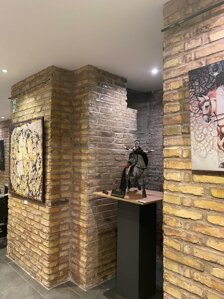
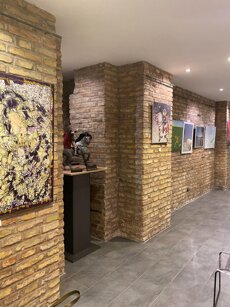
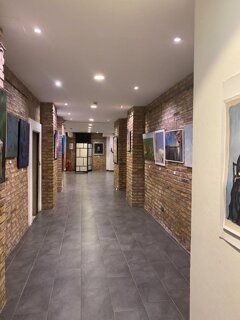
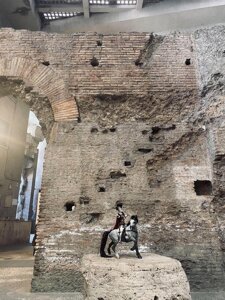
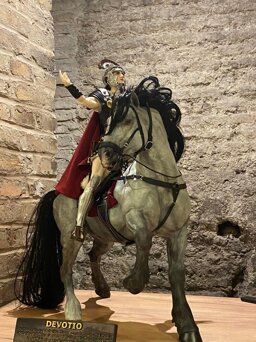
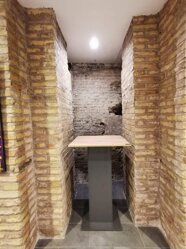
The exhibition committee chose a particularly striking position for Devotio, placing the sculpture on its pedestal directly in front of the surviving ancient masonry of the Stadium of Domitian. The recessed brick walls created a natural architectural frame around the sculpture, giving it a distinctive presence within the archaeological exhibition space. A rather extraordinary setting for an articulated sculpture, surrounded by nearly two thousand years of Roman history.
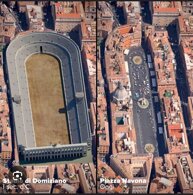
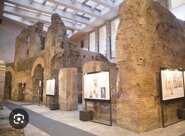
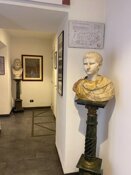
Museum of the Stadium of Domitian, Piazza Navona.
Located approximately 4.5 metres beneath the magnificent Piazza Navona, in the heart of Rome’s UNESCO-listed historic centre, the Museum of the Stadium of Domitian preserves the remains of one of ancient Rome’s most extraordinary architectural achievements.
Inaugurated in AD 86 by Emperor Domitian, it was the first and only masonry stadium built in ancient Rome, originally designed to host athletic competitions before an audience of thousands.
Today, its surviving structures offer a remarkable exhibition setting, where contemporary art encounters nearly two thousand years of Roman history.
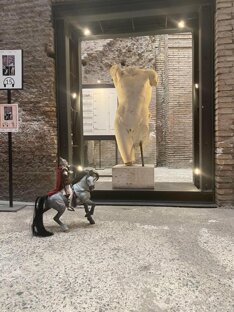
And a little curious note
Who could ever have imagined exhibiting an articulated figure under the same roof as a sculpture of Apollo attributed to Praxiteles, one of the great masters of ancient Greek sculpture and pioneers of sculptural plasticity? For someone whose work revolves around anatomy, movement and the expression of form, that was quite something! Naturally, paying our respects and offering a little salute before heading home was simply mandatory!
XVI International Art Biennale of Rome 2026
In September 2026, I returned to the International Art Biennale of Rome for the second consecutive edition as a sculptor.
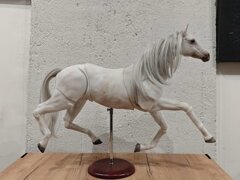
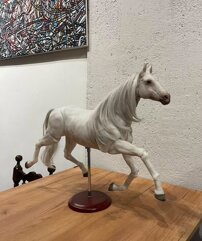
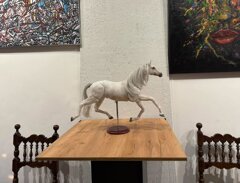
This time, my work was Caesar, a fully articulated equestrian sculpturet, in which anatomy, sculptural form and mechanical engineering come together.
Selected for the XVI edition of the Biennale, FUTURA 2026, Caesar was exhibited at Sala Margana, in the historic heart of Rome.
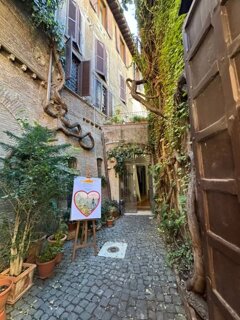
The setting was remarkable. Entering through an old courtyard, surrounded by weathered walls, cobblestones and climbing vines, felt almost like stepping into another century. Beyond it, historic rooms with arches, columns and centuries of architectural history welcomed an international exhibition of contemporary paintings and sculptures.
And somewhere among all that history stood my horse.
A resin sculpture created through contemporary digital and physical techniques, with articulated joints designed as an integral part of its sculptural identity.
Ancient architecture and contemporary sculpture having a little conversation.
But what made this second participation particularly meaningful was the continuation of something that had begun at the previous Biennale.
Once again, a BJD sculpture had been selected and presented as sculptural work, independently of the BJD collecting world. Caesar was not exhibited as a mannequin, a support for clothing or accessories, or a tribute to another artist’s creation.
The sculpture itself was the artwork.
Its anatomy, proportions, articulation, engineering and physical execution were the artistic contribution being presented.
And for me, that distinction remains particularly important.
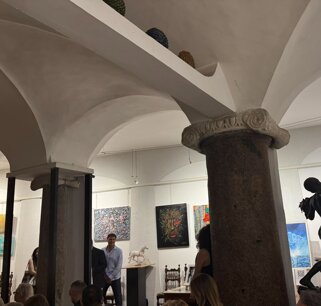
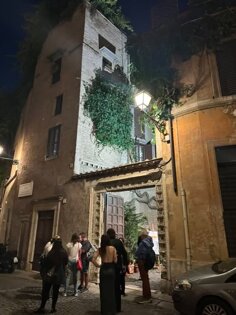
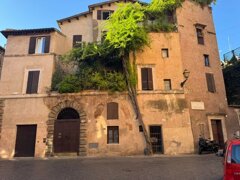
Sala Margana Rome
Nestled in the historic heart of Rome, within the UNESCO-listed city centre and just steps from the Capitoline Hill, Sala Margana is set within one of the Eternal City’s most remarkable medieval architectural environments. Piazza Margana takes its name from the powerful noble Margani family, whose architectural legacy survives in a fascinating ensemble of medieval fortifications, Renaissance palaces and aristocratic residences. What makes this historic setting particularly extraordinary is the presence of architectural fragments inherited from Ancient Rome itself. Roman marble elements, sculpted reliefs, ancient columns and decorative stonework were incorporated into later buildings, preserving tangible traces of the imperial city within centuries of subsequent architecture. Here, ancient Roman craftsmanship, medieval aristocratic heritage and Renaissance architecture converge in a setting of exceptional historical character. Chosen as the venue for the XVI International Art Biennale of Rome in 2026, Sala Margana offered a remarkable backdrop for contemporary art, surrounded by architectural heritage spanning nearly two millennia.
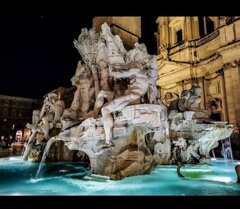
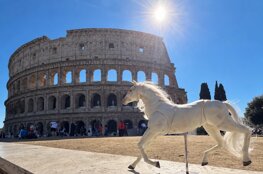
After the exhibition, Caesar enjoyed a little sightseeing on our way back to the car! We stopped at the Fountain of the Four Rivers in Piazza Navona, a place particularly dear to me and closely connected to the previous Biennale, when Amartia, the static horse sculpture, was exhibited at the nearby Stadium of Domitian. And, since our car was parked near the Colosseum, we couldn’t resist a few more photographs there. Two Biennales, two horses, and a little journey through the Eternal City. Apparently, carrying a resin horse through Rome attracts quite a few curious looks!
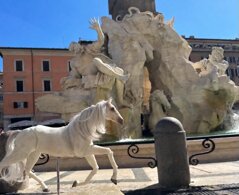
And a little curious note
As it turns out, Sala Margana had
one more surprise in store for me!
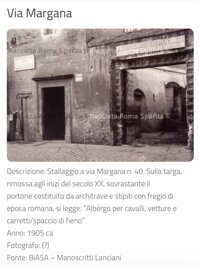
The Biennale was originally meant to take place at the Museum of the Stadium of Domitian, but renovations led to a change of venue. And here’s where the coincidence becomes rather amusing. I later discovered a photograph dating from around 1905 showing the entrance at Via Margana 40. Above the doorway was a sign reading: “Albergo per cavalli, vetture e carretti.” An inn and stable for horses, carriages and carts! More than a century later, completely unaware of this history, I walked through that very entrance carrying Caesar, my articulated resin horse, to be exhibited as contemporary art. And to make the story even better, the entrance incorporated architectural fragments from Ancient Rome, reused in the building centuries later. Coincidence? Destiny? Or perhaps Caesar simply chose his own exhibition venue. Apparently, the horse had found his way home!
What Are the Odds?
Now, seriously… what are the chances of all this happening?
First, Marcus, with his joints, finds himself exhibiting under the same roof as an Apollo attributed to Praxiteles, one of the fathers of sculptural plasticity in art history.
Then, two years later, Caesar, my articulated horse, ends up walking through an entrance that once welcomed horses,
carriages and carts… simply because the Museum of the Stadium of Domitian,
where the exhibition was originally supposed to take place, was undergoing renovations!
I couldn’t have planned either coincidence even if I’d tried!
Sometimes I really do wonder whether my sculptures have minds of their own. And apparently, quite a sense of humour too!