Menu
“The art is as much the process as the finished piece.”
FOLLOW ON
behind the sculpt
3. FROM DIGITAL TO PHYSICAL

Copyright © 2022- huli.dolls
AI Training & Content Use
All original artwork, sculptures, designs, images and written content published on this website are protected by copyright. I do not consent to the use of any content from this website for training, developing, fine-tuning or evaluating artificial intelligence systems, including generative AI models. No permission is granted for automated scraping, extraction, reproduction or inclusion of my work in AI training datasets without my prior explicit written authorisation.
© Hulidolls All rights reserved.
Printing, Post-Processing & Finishing
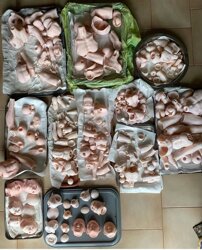
Once the digital sculpt is complete, I personally handle its resin 3D printing, selecting materials and settings according to the requirements of each piece. However, printing is only the beginning of the physical process.
Beyond removing supports, every resin component requires extensive manual work. Each surface is carefully inspected, refined and finished, receiving the same attention I would dedicate to a prototype. This is one of the most satisfying stages of my work, and a major reason why I chose resin 3D printing over production methods that can require less hands-on intervention after the initial prototype.
I wanted a process that would allow me to remain directly involved in the physical creation of every sculpture, working on each individual piece by hand, even when realising
an existing design for another collector.
It is deeply important to me that my hands are the only ones involved in the making of my sculptures, at every stage, from digital creation to physical completion.
This continuity of personal involvement is an essential part of my artistic practice.
Material Choice
The market offers a wide range of 3D printing resins, each formulated to prioritise different mechanical properties. After comparing different formulations, I selected tough resins that offer the balance of strength, flexibility and impact resistance I consider appropriate for my sculptures. Compared with more rigid formulations, its ability to absorb mechanical stress and tolerate a degree of deformation before fracturing is particularly valuable for thin or delicate sculptural elements. While some BJD-specific resins prioritise surface hardness and resistance to joint wear, my choice places greater emphasis on improving the resilience of individual components against accidental impacts, handling and mechanical stress.
For me, preserving fine sculptural details while giving delicate structures a better chance of surviving everyday handling is an essential consideration.
After all, joint wear is an inherent consideration in any articulated BJD, regardless of the material used. Different materials may reduce or delay it, but none can completely eliminate the effects of repeated friction and movement.
3D RESIN PRINTING
Would you rather stick to the usual hearsay, or explore the perspective of someone who’s been working with 3D printing since 2017?
Curious?
Let’s go beyond the myths and see what really happens behind the scenes.