Menu
FOLLOW ON
“The art is as much the process as the finished piece.”
behind the sculpt
4. THE ART OF ARTICULATION

Copyright © 2022- huli.dolls
AI Training & Content Use
All original artwork, sculptures, designs, images and written content published on this website are protected by copyright. I do not consent to the use of any content from this website for training, developing, fine-tuning or evaluating artificial intelligence systems, including generative AI models. No permission is granted for automated scraping, extraction, reproduction or inclusion of my work in AI training datasets without my prior explicit written authorisation.
© Hulidolls All rights reserved.
-PART I Movement & Physical Testing
-PART II Sculptural Plasticity
-PART III Internal Engineering
-PART IV Proportions, Weight Distribution,Scale & Stability
PART I
Movement & Physical Testing
Movement Testing
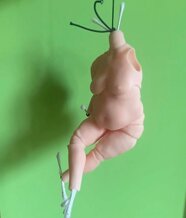
Designing an articulated body involves developing a complex mechanical system in which every joint must work in harmony with the others. While digital sculpting allows me to design and evaluate the geometry of each articulation, one crucial factor cannot be fully predicted: how the internal elastic tension will affect the behaviour of the assembled body. The actual range of movement, joint stability and interaction between components can only be properly evaluated once the physical parts are assembled and strung with elastic. This makes repeated physical testing essential. Bodies often undergo several rounds of assembly, movement tests and adjustments, sometimes requiring modifications to individual components before the articulation performs as intended.
Some mechanical behaviours simply cannot be assessed through geometry alone. They only reveal themselves when the sculpture becomes a functioning physical object.
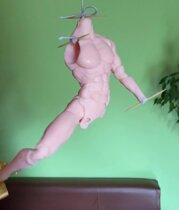
Joint Articulation Testing
at 1/6 scale
PART II
Sculptural Plasticity
One argument I’ve heard countless times within the BJD hobby is that visible joints ruin a sculpture’s aesthetics.
Fair enough. Everyone has their preferences.
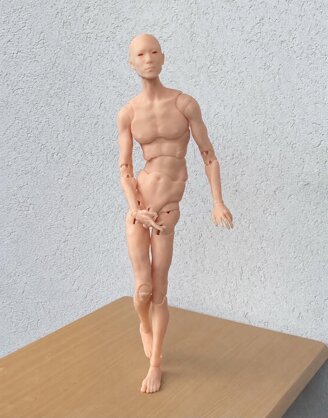
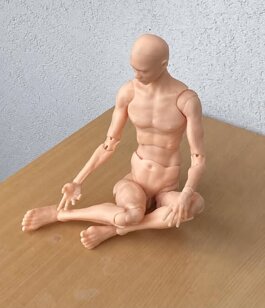
But personally, as a sculptor, I place enormous value on sculptural plasticity: the relationship between volumes, anatomy, balance, tension and the impression of movement.
Think of Praxiteles, whose graceful figures developed the expressive possibilities of classical contrapposto, or Michelangelo, who explored the extraordinary relationship between anatomy, movement and sculptural form. Neither needed actual movement to convey it. Their sculptures could suggest life through the relationships between their volumes. And that’s precisely what fascinates me about articulation.
A change in posture can completely transform the visual rhythm of a figure. Of course, joints interrupt the sculpted surface. But they also allow those relationships to change.
This is why I value a sufficient number of carefully positioned joints. Because each meaningful articulation expands its expressive possibilities. My goal is to balance anatomical continuity with freedom of movement, without sacrificing the sculptural identity of the figure.
Some see the interruption of a surface.
I also see the possibilities of the form.
After all, a BJD may not be able to speak, but it can certainly express itself through its body!
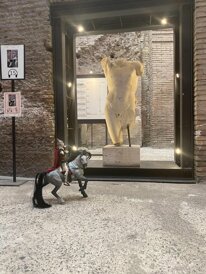
And speaking of Praxiteles…
You can probably imagine the joy of exhibiting one of my own sculptures under the same museum roof as an ancient work attributed to Praxiteles, one of the great pioneers of sculptural plasticity, during the International Art Biennale of Rome.
PART III
Internal Engineering
IAS
Independent Anchoring System
Developed for Huli articulated sculptures
I must admit, this system was born out of my reluctance to repeat an experience I found particularly frustrating: stringing a BJD the conventional way. Rather than going through that ordeal again, I started exploring alternative solutions that could simplify the process, while considering how they might affect the doll’s mechanical behaviour.
The idea was to introduce internal anchoring bars, allowing the elastic cords to be secured at different points instead of running continuously through the body. Finding the right position and height for these anchors required several experiments. My aim was to maximise the independence of each leg’s elastic tension from the torso and minimise the tendency of the body to snap back into itself. What began as a rather lazy attempt to avoid an unpleasant task ended up offering several advantages: easier stringing, independent elastic tension and the opportunity to develop a more complex internal sculptural structure. The last aspect was particularly satisfying. Creating the anchoring system required me to sculpt the inside of the body as well, introducing internal features that are difficult to reproduce through conventional mould-making and casting. As an unexpected bonus, this internal complexity also makes the sculpture more resistant to unauthorised recasting, adding a practical obstacle to unauthorised reproductions of the original design.
Sometimes, the desire to avoid doing something the hard way leads to entirely new sculptural possibilities.
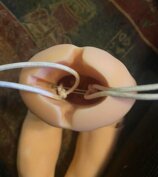
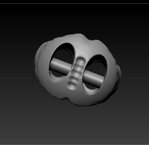
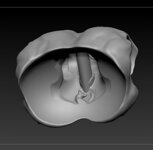
Early development / 1 bar
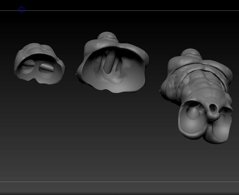
Intermediate development / 3 bars
An Evolving Internal Structure
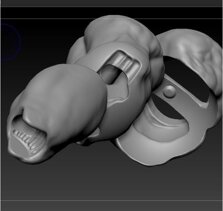
What began as a relatively simple internal anchoring arrangement has continued to evolve through successive body designs. Each new sculpture has given me the opportunity to revisit the system, experiment with different anchoring positions and refine how elastic tension is distributed between articulated sections. The development has been gradual, guided by physical testing rather than theoretical assumptions alone. From the original arrangement shown in the first photograph to the more elaborate internal structures illustrated in the others, each modification reflects something learned through experience. In my latest male body design, the system has evolved to incorporate four separate internal anchoring bars, each serving a specific mechanical purpose. For me, this is one of the most rewarding aspects of developing articulated sculptures: a solution is never necessarily the final one. Each new design offers another opportunity to understand its mechanics better and refine what came before.
Current development / 4 bars & locks
Locking Systems & Controlled Movement
Another aspect that gradually developed through experimentation is the implementation of locking systems within the articulated structure.
As the internal architecture evolved, I began introducing mechanical features designed not only to anchor elastic tension, but also to guide, limit and stabilise the behaviour of specific components.
These solutions help control unwanted rotation, improve alignment between parts and make movement more predictable within the intended range of articulation.
Like the internal bar system itself, these features were not fixed from the beginning. They emerged progressively, body after body, as each new design offered an opportunity to refine how the sculpture moves and how its internal mechanics support that movement.
For me, articulation is not only about flexibility. It is also about control.
PART IV
Proportions,
Weight Distribution & Stability
Body Proportions, Weight Distribution & Stability
Beyond joint geometry and the importance of correctly dimensioned internal channels for elastic strings, there is another crucial factor to consider: how the mass of each component is distributed throughout the articulated body. Body proportions influence more than appearance.
They affect weight distribution, the centre of gravity and the stability of the sculpture.
A female-proportioned body with narrower shoulders and wider hips may concentrate more mass around the pelvis. A male-proportioned body with broader shoulders and a narrower pelvis may carry proportionally more weight in its upper torso.
This becomes particularly relevant in male BJDs combining elongated legs with very broad shoulders. Longer legs position the upper torso farther from the ground, while broad shoulders can introduce considerable additional mass into the upper structure. Together, these proportions may raise the sculpture’s centre of gravity and make its balance more sensitive to changes in posture. As the chest and upper torso move during posing, their weight can shift the body’s centre of mass towards or beyond its base of support, increasing the risk of tipping.
This is where selective thinning of the chest and upper torso components becomes particularly important. Digital sculpting offers a significant advantage here. Individual components can be manually hollowed and selectively refined, allowing precise control over their internal geometry and wall thickness without altering their external anatomy. Sufficient material can be retained around joints, sockets and mechanically stressed areas, while unnecessary mass is removed elsewhere.
The effectiveness of selective wall thinning depends on the overall geometry, joint configuration and intended range of movement, which is why physical prototype testing remains an essential part of my process.
The goal is not simply to make the sculpture lighter, but to control where its mass is concentrated, lowering the centre of gravity where possible and improving balance.
A well-designed articulated sculpture isn’t necessarily the lightest one. It’s one whose weight distribution has been deliberately considered.
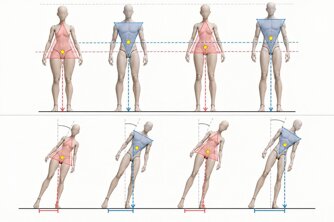
The yellow dots are conceptual indicators, not precisely calculated centres of gravity. Their purpose is to illustrate the relationship between body proportions, mass distribution and balance.
And why am I telling you all this? Well… I want my dolls to inherit something from me: my long legs! (oh, and say hi to my old doggie!)
Unfortunately, I also have a terrible weakness for boys with a nice pair of broad shoulders… Long legs. Broad shoulders. A higher centre of gravity.
Oh yeah, I’m doomed.
Apparently, my sculptural preferences are creating my own engineering headaches.

Balance, Joint Stability & Scale
When discussing the stability of an articulated sculpture, I believe it’s important to distinguish between two different aspects:
overall balance and joint stability.
They are closely related, but they are not the same thing.
Overall balance concerns the sculpture’s ability to remain upright without tipping over. It depends on the position of its centre of gravity in relation to its base of support, as well as the distribution of mass throughout the body.
Joint stability, on the other hand, concerns the ability of individual articulations to maintain their positions under load. It depends on joint geometry, friction, elastic tension and the forces acting on each component.
And increasing scale makes both aspects more challenging. For example, when a sculpture is enlarged proportionally while maintaining the same material density and relative mass distribution, doubling its linear dimensions produces approximately eight times the mass and sixteen times the gravitational torque acting on corresponding joints.
And the greater the number of articulated components, the more potential points of movement must be controlled.
More joints, more pain!
Digital sculpting allows me to address some of these challenges through selective hollowing, weight distribution, wall thickness adjustments and joint design. But these interventions cannot eliminate the mechanical consequences of increasing scale.
I’m the first to admit that the stability of my sculptures changes considerably between smaller and larger scales.
A sculpture’s ability to remain standing and its joints’ ability to maintain a pose must be considered separately, even though they influence one another. A doll that falls over doesn’t necessarily have poorly functioning joints. And a doll that remains standing doesn’t necessarily have joints capable of supporting every pose.
1/6 scale
1/4 scale
See the handsome little fellows in the video, with their broad shoulders and long legs? Look at how confidently they stand at 1/6 scale.
Now forget about expecting that same behaviour at 1/3 scale! At that size, I’m just happy that he doesn’t
fall flat on his face!!
1/3 scale
The sculptural plasticity and posing freedom I aim for come at a price.
Both figuratively and literally. Larger scales may require a stand for more adventurous, acrobatic poses. And a greater number of joints means not only more engineering challenges, but also considerably higher production costs at any scale: more individual components, more material, more surfaces to finish, and more parts to assemble and test.
More pieces, more pain!
But the expressive possibilities they offer? Off the charts.
And to me, absolutely worth it.
“The result? Bodies that bend like kitties, with a range of movement and posing possibilities that make all those engineering headaches worthwhile."
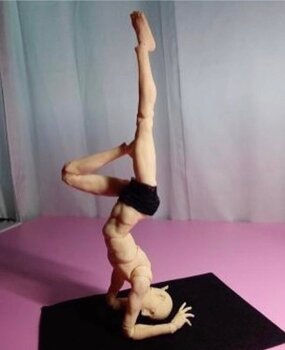
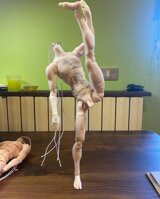
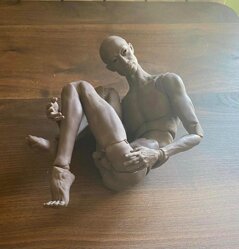
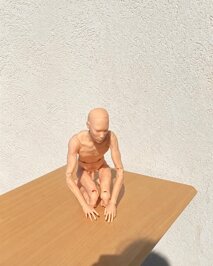
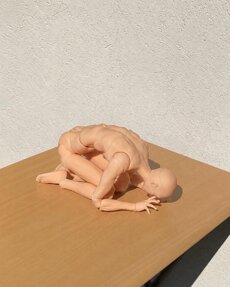
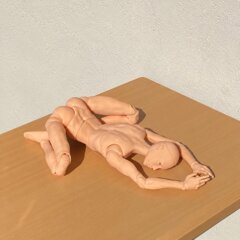
The question was: “Can he bow to pay his respects to his elders?”
His answer:
“Of course I can! I can even flatten myself against the floor to pay my respects to my Domina.” 😏🤣
Well… nobody asked for THAT demonstration, darling. 😂