Beyond Facial Portraiture
The same principles of anatomical observation, proportion and structural accuracy guide my approach to full-body sculpture. Whether working on a face or an entire figure, I study the relationships between anatomical structures and volumes, translating those observations into three-dimensional form. With articulated bodies, an additional challenge emerges: integrating movement into the sculptural design without compromising anatomical coherence. Articulation therefore becomes part of the creative process itself, requiring both digital development and physical testing.
For a closer look at how movement becomes part of sculptural design, explore The Art of Articulation
Menu
FOLLOW ON
“The art is as much the process as the finished piece.”
behind the sculpt
2. THE SCULPTING PROCESS

Copyright © 2022- huli.dolls
AI Training & Content Use
All original artwork, sculptures, designs, images and written content published on this website are protected by copyright. I do not consent to the use of any content from this website for training, developing, fine-tuning or evaluating artificial intelligence systems, including generative AI models. No permission is granted for automated scraping, extraction, reproduction or inclusion of my work in AI training datasets without my prior explicit written authorisation.
© Hulidolls All rights reserved.
-Reference & Sculpt Comparison
-Traditional Foundation & Digital Expression
-Realism and Minimalism Are Not Opposites
-Facial Asymmetry & The Paradox of Accuracy
From Observation to Form
Whenever possible, I work with 10–20 reference photographs taken from different angles. Comparing multiple images helps me identify the subject’s actual proportions while accounting for lens distortion, focal length, perspective, lighting, makeup and other factors that can alter their appearance. From there, I translate those observations into three-dimensional form, continuously refining proportions, volumes and anatomical relationships.


Reference & Sculpt Comparison
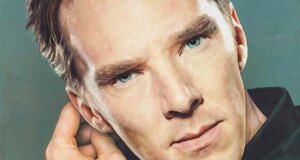
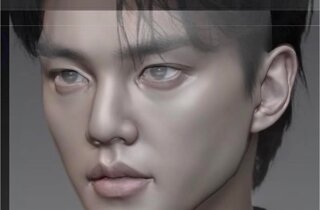
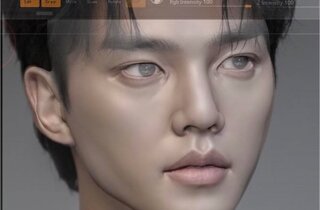
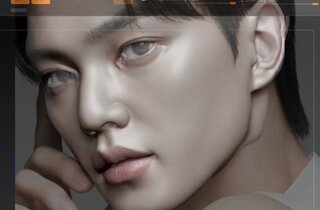
Once a sculpt is complete, I present it at partial transparency over multiple reference photographs taken from different angles, allowing viewers to compare the facial proportions, anatomical landmarks and spatial relationships for themselves and assess how closely the sculpt captures them from different angles.

Traditional Foundation &
Digital Expression
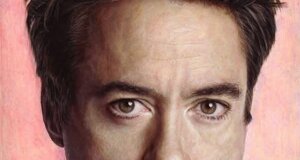
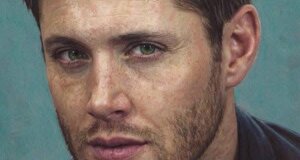
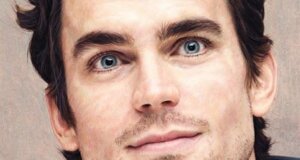
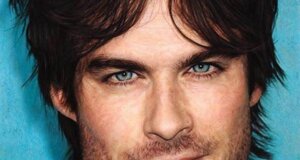
My artistic foundations were developed through years of working with traditional media, including realistic portrait drawing and hand sculpting. The portraits below offer a glimpse into that earlier work, reflecting the same understanding of anatomy, proportions, facial topography and likeness that I later carried into digital sculpture. The medium evolved, but the artistic foundation remained.
A selection of my traditional portraits, created with watercolour pencils, pastels, inks and acrylic paints. These pieces reflect the artistic foundations I later carried into my digital sculpting practice.
Beyond the “ GUESS WHO” Game
One of the most interesting aspects of portrait sculpture is exploring how a likeness emerges from the relationship between proportions, volumes and anatomical details.
And rather than simply asking “Who does this remind you of?”, I enjoy giving viewers the opportunity to examine those relationships for themselves.
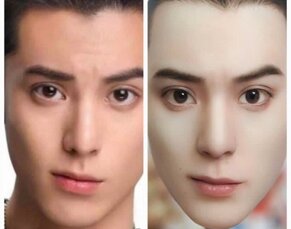
Here’s the reference. Here’s my sculpt. Take a closer look!
By presenting my sculptures at partial transparency over reference photographs taken from different angles, viewers can compare facial proportions, anatomical landmarks and spatial relationships for themselves. Look at why the resemblance works,
and whether it holds up beyond a single flattering viewpoint.
That’s one of the things I particularly appreciate about digital sculpting: it allows me to present these comparisons with a level of visual transparency that would otherwise be considerably more difficult to achieve. And my confidence in presenting my work this way comes from my foundations in traditional drawing and portraiture. My ability to observe, understand and reproduce facial anatomy, proportions and three-dimensional form wasn’t developed through digital tools. Those are skills I cultivated through traditional artistic practice and continue to apply to my digital sculptures.
Digital sculpting didn’t teach me how to see. It gave me additional ways to translate, examine and demonstrate what I see. After all, transparency is available to anyone using digital tools.
It doesn’t magically correct proportions, anatomical landmarks or facial topography. If the underlying sculpture is inaccurate, an overlay won’t hide that. Quite the opposite: it can make those inaccuracies painfully obvious.
And that’s precisely why I’m perfectly happy to show mine.
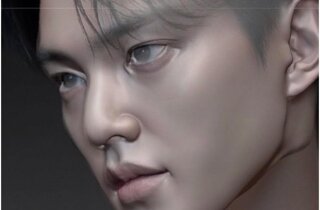
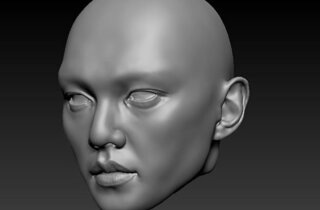
Realism and Minimalism Are Not Opposites
Realism and minimalism are often treated as mutually exclusive, but they are not.
They describe different aspects of a sculpture. A highly detailed sculpture is not necessarily realistic, just as a sculpture with very few surface details is not necessarily stylised. Even a caricature can be rich in detail while deliberately exaggerating proportions.
In my portrait sculptures, realism comes primarily from the accuracy of proportions, anatomy and individual facial characteristics. Minimalism comes into play in how selectively I use surface details. I sculpt only what is necessary to define the forms, clarify transitions between planes and provide a subtle guide for faceup.
The volumes are already present in the sculpture. Light interacting with those surfaces creates natural highlights and shadows, allowing colour to enhance the face rather than having to construct its underlying forms. My aim is not to achieve realism through an accumulation of details, but through the accuracy of the forms themselves.
Take a closer look at the resin sculpture in the video above. Beyond the proportions and facial features, notice how light alone brings out the sculpted forms.
As it moves across the surface, subtle changes in brightness and shadow reveal the transitions between facial planes, giving the face depth and definition without any painted details.
The sculpture doesn’t need colour to establish its volumes.
They are already there, waiting for the light to reveal them.
This is also why I prefer to present my sculptures in their raw digital form, using a simple material without textures or elaborate rendering. It allows viewers to examine the proportions, volumes and actual surface details without the distractions of effects designed to enhance their appearance. Photographs of the physical sculpture can introduce another variable. Depending on the lighting, camera angle and photographic conditions, they can emphasise certain features while concealing others, changing how the forms are perceived.
The raw digital sculpt offers a more consistent way to examine the work, with fewer visual variables affecting how its forms and surface details are perceived. You see the same geometry and surface details I work with while sculpting. Everything you see sculpted into the digital surface is also present in the physical resin sculpture.
My intention is simple: to let you judge the sculpture itself, rather than how convincingly it has been presented.
The Amount of Surface Detail
The level of detail in my sculptures is a deliberate choice, regardless of whether I’m sculpting a real person or a fictional character.
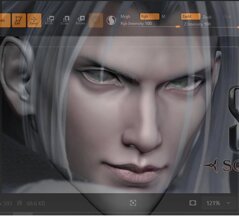
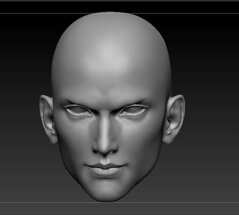
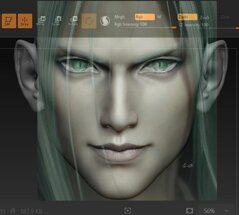
Take Sephiroth, for example. Despite originating from a video game released in 1997, with far less elaborate graphics than today’s, the amount of surface detail in my sculpt is comparable to what I use in my portraits of real people. My priority is to preserve the proportions, volumes and distinctive features of each subject, without adding unnecessary detail.
I deliberately keep the surfaces relatively simple because, for my BJD heads, I find that a more selective use of detail serves the sculpture better than pursuing hyperrealism. Excessive detail can also create a visual imbalance when combining heads with bodies from different makers. I prefer to provide a subtle guide for the faceup through the sculpted forms, leaving room for individual interpretation without sacrificing the character of the original subject.
Facial Asymmetry & The Paradox of Accuracy
What if reproducing a face too accurately actually made the portrait look less like the person?
It sounds contradictory, but this is something I learned years ago, working with traditional portraiture. Every human face is asymmetrical. Some more noticeably than others. And those differences are often part of what makes a face unique and recognisable.
But here’s where things get interesting.
-When we look at someone’s face, or even at a photograph, we perceive it as a whole. We recognise the individual without consciously analysing every difference between the two sides.
-When we look at a drawn or sculpted portrait, however, our perception can shift. We may become more critical of differences that would barely attract our attention in the original face, almost instinctively searching for mistakes. An uneven eye, a slightly displaced mouth, or a difference in the jawline can suddenly appear exaggerated in its artistic representation, even when those features are faithfully observed.
The paradox is that an asymmetry can be anatomically accurate and still look like a sculpting mistake.
So how do I deal with this?
I don’t eliminate asymmetry, nor do I reproduce every difference with absolute fidelity. Instead, I deliberately soften certain irregularities while preserving those that contribute to the individual’s recognisable features.
You could call it a subtle form of idealisation, but the intention isn’t to make the person more conventionally beautiful or symmetrical.
It’s about finding a balance between anatomical accuracy and perceptual likeness. Because sometimes, being a little less literal is precisely what makes a portrait feel more true to the person.
¼ scale
owner @layemaya365
faceup by @357partment

Beyond Facial Portraiture
The same principles of anatomical observation, proportion and structural accuracy guide my approach to full-body sculpture. Whether working on a face or an entire figure, I study the relationships between anatomical structures and volumes, translating those observations into three-dimensional form. With articulated bodies, an additional challenge emerges: integrating movement into the sculptural design without compromising anatomical coherence. Articulation therefore becomes part of the creative process itself, requiring both digital development and physical testing.
For a closer look at how movement becomes part of sculptural design, explore The Art of Articulation
