Menu
COLOURS &
VOLUME ADAPTATION
FOLLOW ON

Copyright © 2022- huli.dolls
AI Training & Content Use
All original artwork, sculptures, designs, images and written content published on this website are protected by copyright. I do not consent to the use of any content from this website for training, developing, fine-tuning or evaluating artificial intelligence systems, including generative AI models. No permission is granted for automated scraping, extraction, reproduction or inclusion of my work in AI training datasets without my prior explicit written authorisation.
© Hulidolls All rights reserved.
“A unique doll starts with a unique sculpt.”
For me, a doll’s individuality begins with its sculptural form, before painting, clothing or styling enter the picture.
This principle runs through all my BJD work,
whether developed within the Huli Project or undertaken as an independent commission.
PART I. PERSONALISING YOUR SCULPTURE
-Colors Available
-Custom size & Volume Adaptation
-The Adaptation Process
-What Happens When You Order An Existing Head Design
-Two Components One Sculpture
PART I. PERSONALISING YOUR SCULPTURE
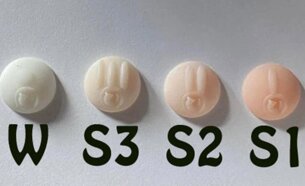
1. COLORS AVAILABLE
To preserve the mechanical properties and performance of the resins I use, I offer my sculptures in the colours listed below.
one caution: a photograph cannot guarantee
exact colour matching across screens
2. CUSTOM SIZE & VOLUME ADAPTATION
Hybrids Beyond Head Circumference
A common approach to creating hybrid BJDs is to rely on head circumference and neck socket measurements to determine compatibility. While useful, these measurements have significant limitations when dealing with realistically proportioned faces and their natural anatomical diversity. Head circumference alone tells us little about how volumes are distributed. Cranial height, cheekbone width and projection, jaw structure, chin shape and overall facial length all influence the perceived size and proportions of a head.
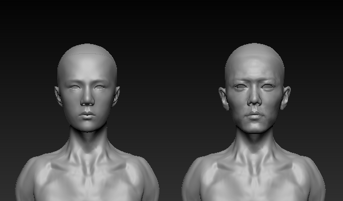
Two heads with similar circumferences can therefore look remarkably different, even when placed on the same body. For example, a face with a broad, square jaw may appear fuller and more substantial than one with a narrow, triangular chin. Yet their head circumferences could be nearly identical. The relationship with the body adds another variable. Shoulder width, neck proportions and overall body structure can significantly affect how large or small a head appears.
Same Circumference, Different Proportions These two head sculpts were deliberately created with identical head circumferences, allowing them to share the same wig. Both are presented on the exact same body, with only their facial structures differing. Yet the perceived relationship between head and shoulders changes noticeably. XZ’s face is neither distinctly triangular nor particularly broad or square-jawed. If the difference is already noticeable here, imagine how much more pronounced it could become with a face like Henry Cavill’s, characterised by a considerably broader, more angular jaw. This illustrates why identical head circumferences do not necessarily translate into identical visual proportions. Physical compatibility is only one aspect of a successful hybrid.
Facial structure and its relationship with the body’s proportions deserve equal consideration.
During the early development of the Huli Project, I experimented with relying primarily on head circumference and neck socket measurements. However, I found this approach inadequate for my realistically proportioned head sculpts. A head could fit a body perfectly and still look completely out of proportion.
This led me to develop a different approach, one that evaluates the head’s overall volume, facial structure and relationship with the intended body rather than relying on circumference alone.
The goal is not simply physical socket compatibility, but allowing each collector to choose the proportions they find most harmonious.
3. THE ADAPTATION PROCESS

STEP 1 Body Measurements
You provide three measurements of your BJD body:
*Body height, specifying whether the measurement includes the head
*Shoulder width
*Neck circumference
STEP 2 Digital Body Reference
Using these measurements, I adjust a digital dummy body to match the relevant proportions of your doll.

STEP 3 Choosing the Head Volume
The selected head sculpt is placed on the adjusted digital body, allowing you to evaluate different head volumes in relation to the shoulders, neck and overall body proportions. You decide which proportions look best on your doll.
Limitations of the Method
This procedure is not without limitations. While neck circumference is taken into account, the actual height and shape of the neck, as well as the depth and geometry of the head’s neck socket, are not fully evaluated. These factors can influence the overall appearance of the hybrid. I deliberately kept the process simple, relying on measurements collectors can usually find in their dolls’ official specifications, without requiring them to take additional measurements themselves.
Despite these limitations, i have found this method remarkably effective in my own work over the years, particularly with bodies for which the traditional head-circumference approach had repeatedly failed to achieve satisfactory visual proportions.
PART II. BEHIND YOUR ORDER
WHAT ACTUALLY HAPPENS
WHEN YOU ORDER AN EXISTING HEAD SCULPT?
2. INITIAL RESIZING & VOLUME ADAPTATION
Actions:
* I prepare a digital dummy body according to your doll’s measurements.
* I adjust the initial volume and proportions of the head to suit the intended body.
* I prepare and present a visual preview for your approval.
Materials & resources:
* Digital sculpting software.
* Computer hardware and electricity.
* Digital modelling and preparation time.
1. INITIAL REQUEST & INFORMATION
Actions:
* You select the sculptural design you would like.
You provide the measurements of your doll and your preferred resin colour.
I review the information and assess the necessary adaptations.
* I process the order and payment, manage the transaction and associated order records.
* If measurements or other essential details are missing, I contact you to request them. Hopefully, you’ll provide everything from the beginning. Otherwise, we’re already adding an extra round of messages before I’ve even started!
Materials & resources:
* Communication and administrative time.
* PayPal transaction fees.
* Etsy fees, where applicable.
4. FINAL SCULPTURAL & MECHANICAL ADAPTATIONS
Actions:
* Once the proportions are approved, I create and refine the necessary neck, eye and magnet sockets.
* I resculpt affected areas and modify the geometry wherever needed.
* I check the model's geometry for physical realisation and resculpt where needed.
Materials & resources:
* Digital sculpting software and computer equipment.
* Sculpting and technical preparation time.
3. REVISIONS & APPROVAL
Actions:
* If you request further changes to the head’s volume, I make the necessary adjustments.
* I prepare an updated preview and present it for approval.
* The process continues until we agree on the final proportions.
Materials & resources:
* Digital sculpting software and computer equipment.
* Additional sculpting and communication time.
5. SUPPORT PREPARATION & RESIN COLOUR MATCHING
Actions:
* I manually position the printing supports.
* I run tests or correct potential support issues where necessary.
* I prepare and mix the resins to achieve the requested colour.
Materials & resources:
* Slicing and support-preparation software.
* Resin preparation.
* Mixing containers, measuring tools and other consumables.
* Protective equipment.
* Preparation and testing time.
6. RESIN PRINTING
Actions:
* I calibrate and operate the resin printer.
* I monitor the printing process as needed.
* I clean the printer.
* I check the finished print for defects or failed areas.
Materials & resources:
* Resin 3D printer and its consumable components. * Prepared resin mixture.
* Electricity.
* Equipment usage, wear and maintenance. Approximate printing time for a 1/3 scale head: 5 hours.
8. EXTENSIVE MANUAL FINISHING
Actions:
* I inspect the entire surface of the sculpture.
* I manually sand and refine the surface.
* I eliminate visible printing artefacts where present, correct support marks and other imperfections. (sanding, resin,UV curing and further sanding)
* I clean the sculpture again after finishing.
* I manually inspect and refine the eye sockets where necessary.
Materials & resources:
* Sandpaper and abrasive materials of different grades.
* Manual finishing tools.
* Cleaning materials and consumables.
* Protective equipment.
* Manual finishing time.
7. CLEANING & POST-CURING
Actions:
* I remove the printing supports.
* I hand clean the printed sculpture to remove residual uncured resin.
* I carry out the necessary UV post-curing.
Materials & resources:
* Cleaning solvents and washing supplies.
* Cleaning containers and equipment.
* UV curing equipment.
* Protective gloves and other safety consumables.
10. CERTIFICATE & PACKAGING
Actions:
* I prepare the accompanying certificate.
* I protect and package the finished sculpture.
* I prepare the parcel for shipment,organise the shipping and prepare the relevant documents.
Materials & resources:
* Certificate paper, printing supplies and related materials.
* Protective wrapping and cushioning materials
* Boxes and packaging materials.
* Labels and packing consumables.
* Packaging and administrative time
9. FINAL ASSEMBLY & QUALITY CONTROL Actions:
* I attach the necessary magnets.
* I check their alignment, polarity and fit.
* I inspect the finished sculpture and try the eye sockets
Materials & resources:
* Magnets & superglue
* Inspection and quality-control time.
TWO COMPONENTS, ONE SCULPTURE
Every sculpture involves two main components: artistic work and physical realisation.
-The artistic component includes both the creation of the original digital sculpt and its individual customisation, such as adjustments to proportions, volumes and mechanical connections.
Within the Huli Project, neither the original sculpting of existing designs nor their standard individual adaptations carry a sculpting fee. Extensive manual finishing is also provided without a labour charge.
-The price of physical realisation covers resin printing and its associated material and operational costs, including consumables, equipment, finishing materials, magnets, packaging and applicable transaction fees.
A professional printing service charges for physically realising a digital file, not for the artistic creation it represents or the identity of its subject. That distinction became the foundation of how I approached resin realisation costs within the Huli Project.
The physical realisation is priced independently of the artistic work itself. In short, you pay for the physical realisation,
not for the artistic or manual labour I personally contribute.