Menu
FOLLOW ON
THE ELEPHANT IN THE ROOM
Exclusivity, Commercial Use, Copyright &Third-Party Rights 🐘

Copyright © 2022- huli.dolls
AI Training & Content Use
All original artwork, sculptures, designs, images and written content published on this website are protected by copyright. I do not consent to the use of any content from this website for training, developing, fine-tuning or evaluating artificial intelligence systems, including generative AI models. No permission is granted for automated scraping, extraction, reproduction or inclusion of my work in AI training datasets without my prior explicit written authorisation.
© Hulidolls All rights reserved.
-Copyright &Third-Party Rights
-Why the Huli Project is Structured This Way
-Two Components, One Sculpture
Let’s address something that seems to generate quite a bit of confusion:
commissioning a sculpture, purchasing a physical artwork, obtaining exclusivity or commercial use permission,
and acquiring intellectual property rights
are not the same thing.
🐘 Exclusivity & Commercial Use
EXCLUSIVITY
An exclusive commission means that the sculptural design is reserved for the person commissioning it and will not be made available to other collectors. Exclusivity concerns only the availability of that particular design.
It should not be confused with the creation of different interpretations, commercial usage rights or the transfer of intellectual property rights to any of my sculptures.
In simple terms: you’re paying for a design that I won’t offer to anyone else, not for the rights to reproduce it, manufacture copies or use it commercially. Such rights are not automatically included in an exclusivity agreement.
COMMERCIAL USE
Commercial use of my sculptures may be considered under individually agreed conditions, regardless of whether the design belongs to the Huli Project or was created as an independent commission.
There is an important distinction between commissioning a sculpture based on someone’s likeness for private use and commissioning that same likeness for a commercial project. My willingness to create a portrait for a private collector does not automatically extend to commercial applications of that design. If you have a commercial project in mind, please explain its intended purpose from the beginning.
Such requests require a separate evaluation, taking into account the proposed use, the rights involved and any necessary third-party authorisations.
Commercial use and exclusivity are separate matters. A sculpture does not need to be exclusive to be considered for commercial use.
I am open to commercial collaborations, but I do not license my sculptural designs for reproduction or mass production. Requests to manufacture copies (my original works or derivative works), whether directly or through third parties, will not be considered.
My authorisation extends only to rights I am entitled to grant.
COPYRIGHT & THIRD-PARTY RIGHTS
-I retain artistic authorship and copyright over my original sculptural work.
-Commissioning or purchasing one of my sculptures does not transfer those rights, nor does it entitle anyone to claim my work as their own.
-My original digital sculpting files remain private and are never sold, distributed or licensed. Collectors acquire only the individually realised physical sculpture, not the underlying digital design or its reproduction rights.
- I do not grant licences or permission to scan ,reproduce, cast, 3D print or commercially distribute copies of my sculptures or their derivative works, physical or digital. This applies regardless of the extent of the modifications made.
-Modifying My Sculptures:
I deliberately design my heads with thick walls, allowing collectors to sand, carve and resculpt their surfaces. I do not compromise on material thickness simply to save resin. The only area requiring particular caution is around the eyes, where the walls are thinner.
Collectors are free to modify their physical sculptures as they wish, including creating their own artistic interpretations.
They may claim authorship of their own creative modifications, but not of the underlying sculpture. They are free to modify, keep or resell their individual physical sculpture.
When publicly presenting modified works, collectors must acknowledge the original Hulidolls sculpture and provide a link to it.
I provide sculptures for collectors to enjoy and personalise, not sculptural foundations for third parties
to build commercial products upon.
-I do not claim ownership of third-party rights, nor can I grant permissions that do not belong to me. Anyone intending to use a sculpture for purposes requiring third-party authorisation is responsible for obtaining the necessary permissions.
PORTRAITS, PUBLIC FIGURES AND ITALIAN LAW
As an artist working in Italy, I have to take the legal framework surrounding my work seriously.
1. And here’s something worth clarifying: Italian law does recognise exceptions to the requirement for consent when using portraits of public figures. Article 97 of Law No. 633/1941 includes exceptions relating to notoriety. These exceptions have their own conditions and limitations, and laws in other countries may approach the subject differently.
2. There’s also a rather persistent misconception I’d like to address. Changing the name of a sculpture does not magically eliminate the rights associated with the person it represents. People sometimes confuse disputes involving the unauthorised use of a commercial name, brand or trademark with questions concerning a person’s likeness and identity. They’re not the same thing. Removing a protected name may address one particular issue, but it doesn’t automatically resolve the others.
3. And no, making the resemblance less accurate isn’t necessarily enough either. Italian legal interpretations have recognised that a person may remain identifiable even through stylised, exaggerated or otherwise imperfect representations.
WHY THE HULI PROJECT IS STRUCTURED THIS WAY
When I established the Huli Project, I had already spent years creating fan art, particularly portraits of real people and public figures, and was well aware of the complexities surrounding artistic portraits and third-party rights.
I wanted to find a way to keep sculpting, sharing my work and accommodating individual requests without pretending to own rights that aren’t mine.
So I chose to approach each sculpture as an individual work of portraiture, without charging for the artistic creation itself.
An existing head sculpt is a starting point, not a ready-to-print repeatable product. Each commission requires its own digital sculpting adjustments and preparation before physical production.
Rather than assigning a commercial value to the identity, popularity or recognisability of a subject,
I chose to separate artistic creation from the costs of physically realising a sculpture in resin.
INVOLVING COLLECTORS IN THE CREATIVE PROCESS
Initially, even requests for entirely new designs carried no sculpting fee.
A symbolic fixed contribution was later introduced solely to discourage requests lacking genuine interest and to support the continuation of the project, not to compensate for artistic work.
After all, I could simply create new designs on my own initiative without involving collectors or considering their needs.
This contribution is waived when a request is placed by a group of at least four collectors.
Choosing to involve collectors in the creative process is precisely what distinguishes the Huli Project from a collection of sculptures developed solely according to my personal artistic vision.
The Huli Project was built around artistic creation and individual sculptural interpretation, not commercial exploitation.
Its structure reflects a deliberate artistic and economic choice.
TWO COMPONENTS, ONE SCULPTURE
But let’s also take a closer look at the economic reasoning behind the project.
Every sculpture based on existing designs within the Huli Project involves two main components:
artistic work and physical realisation.
-ARTISTIC COMPONENT
Existing designs and their standard individual adaptations carry no sculpting fee. Extensive manual finishing is also provided without a labour charge.
-PHYSICAL REALISATION
Physical resin realisation is priced according to the technical resin work, materials, equipment and resources required.
The price of physical realisation covers resin printing and its associated material and operational costs, including consumables, equipment, finishing materials, magnets, packaging and applicable transaction fees. A professional printing service charges for physically realising a digital file, not for the artistic creation it represents or the identity of its subject. That distinction became the foundation of how I approached resin realisation costs within the Huli Project. The same pricing criteria would apply if someone supplied their own digital sculpting file for me to realise in resin. Whether the subject is a celebrity, their granny, or an original creation makes absolutely no difference to those criteria.
-INDIVIDUAL REALISATION, NOT PRODUCTION RUNS
And there’s another important distinction. Every resin sculpture is a unique, bespoke, made-to-order artistic work.
Nothing is pre-made or kept in stock, and there are no production batches or runs of identical copies. Even when different collectors request the same design, its proportions, volumes and mechanical connections are individually adapted to their requirements.
My original digital sculpting files remain private and are never distributed or licensed for reproduction.
-WHAT YOU ACTUALLY PAY FOR
The physical realisation is priced independently of the artistic work itself.
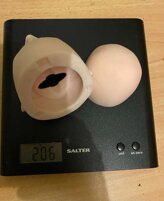
In short, you pay for the physical realisation, not for the artistic or manual labour I personally contribute. To put things into perspective, a 1/3 scale head requires approximately five hours of resin printing alone. Professional resin printing services where I live charge around €20+VAT per printing hour, bringing the printing cost alone to approximately €122, before considering additional expenses.
The Market Cost of Resin Printing
For reference, here is what professional 3D resin printing services charge to produce a 1/3 scale BJD head from an existing digital file, using standard resin.
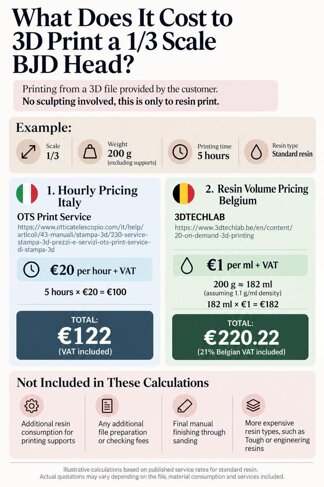
My physical production involves considerably more than printing alone, including:
-More expensive resin types, such as Tough resin
-File preparation and checking
-Manual finishing, including sanding and related materials
-Packaging, magnets and Certificates of Authenticity (COA)
Unlike professional printing services operating at higher production volumes, I produce relatively small quantities, without the same opportunity to distribute operating costs across a large number of daily orders.
The calculations above are based on publicly advertised service rates.
-WHERE THE HULI PROJECT ENDS
And while we’re at it, let’s clarify one more thing.
The Huli Project’s special conditions apply only to the artistic work I choose to offer within the project.
If you request modifications on existing designs, beyond the standard adaptations, additional sculptural work comes at a cost.
If you want an exclusive design, a strictly personal commission or permission for commercial use, those come with their own fees and individually agreed conditions.
There’s absolutely nothing wrong with requesting any of these things. I’m happy to discuss them!
But please don’t confuse what I voluntarily offer through the Huli Project with artistic work or rights
you’re automatically entitled to receive for free or at low cost.
Choosing to waive my sculpting fee for the benefit of private collectors is one thing. Allowing others to profit commercially from that decision, or to treat my time and skills as something they’re entitled to, is an entirely different matter.
I sculpt without charging for my artistic work, but entirely on my own terms.