Menu
SHIPPING, PACKAGING & CERTIFICATE OF AUTHENTICITY
FOLLOW ON

Copyright © 2022- huli.dolls
AI Training & Content Use
All original artwork, sculptures, designs, images and written content published on this website are protected by copyright. I do not consent to the use of any content from this website for training, developing, fine-tuning or evaluating artificial intelligence systems, including generative AI models. No permission is granted for automated scraping, extraction, reproduction or inclusion of my work in AI training datasets without my prior explicit written authorisation.
© Hulidolls All rights reserved.
SHIPPING - THE FAST ROAD
When it comes to shipping my sculptures, I prefer the fast road. I use express couriers, primarily DHL and UPS, rather than traditional postal services. To calculate shipping costs, all I need is your postal code, city and country. I’ll check the available DHL and UPS services, provide you with the corresponding estimates, and you’re free to choose whichever available option suits you best.
PACKAGING - PROTECTION OVER PRESENTATION
I’ve never been particularly fond of fancy packaging.
Don’t get me wrong. I understand that an elaborate box can enhance the unboxing experience. But personally, I consider decorative packaging an unnecessary use of resources and money.
When I don’t even charge collectors for my own artistic and manual labour, spending extra money on elaborate boxes, only to pass that expense on to them, would not only make very little sense to me …it would seem downright stupid!
And there’s also an environmental consideration. Why manufacture and purchase additional decorative packaging when perfectly usable materials can be given a second life?
I’m not claiming my packaging is entirely environmentally friendly. Protective materials such as bubble wrap and packing tape still have their environmental impact. But I do believe that reusing existing materials, reducing unnecessary purchases and avoiding purely decorative waste are sensible choices.
I’d rather put those resources where they actually matter: protecting the sculpture during transportation.
HEAD SCULPTURES: For heads, I reuse the cardboard boxes in which my resin bottles arrive. They’re practical, appropriately sized and already available, so why throw them away only to purchase another box? Add protective bubble wrap, plenty of packing tape …
and yes, I mean plenty! … and they’re ready for their next journey.
BODY SCULPTURES: Bodies require a different approach. For these, I purchase wooden transport boxes originally designed to carry Magnum champagne bottles.
My reasoning is rather simple: wooden boxes designed to transport heavy glass bottles provide a sturdy outer enclosure, while the protective cushioning inside helps absorb shocks and prevent the sculpture from moving during transport.
And considering that parcels sometimes seem to become part of an international Jenga championship, with other heavy boxes stacked on top of them, I’d rather give my sculptures some structural protection!
Inside, I use protective bubble wrap and paper cushioning. The wooden box is then placed inside an outer recycled cardboard carton.
And there’s another reason why my packages tend to look as though they’ve survived a few tape wars.
The rather rough presentation serves a dual purpose. All that cardboard, protective wrapping and tape is there to help the sculpture arrive safely, but I also prefer my parcels to attract as little attention as possible while travelling.
After all, nothing screams “Keep me! Open me!” quite like a beautifully presented, fancy package.
My packaging isn’t designed to impress anyone when they open the box. It’s designed to help the sculpture arrive safely, discouraging opportunistic attention and without creating unnecessary waste along the way.
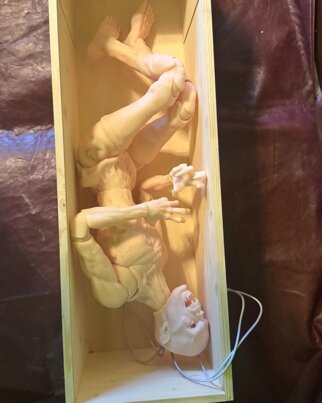
A rather unconventional shipping arrangement… Here I was, checking whether this 68 cm unholy creature would fit inside his wooden shipping crate before wrapping him up. Unfortunately, I realised the crate looked suspiciously like a coffin. Then again, what better way to ship a vampire?
And this, ladies and gentlemen, is why I occasionally find myself laughing alone in my workshop.
CERTIFICATE OF AUTHENTICITY
A Little Story Behind the Certificate
When I first started creating BJD sculpts, I was already familiar with the Certificates of Authenticity accompanying dolls in my own collection.
What hadn’t occurred to me was that collectors would expect one from me as well!
After all, I wasn’t producing numbered editions or limited series. My sculptures were originally bespoke, one-of-a-kind works. And, most importantly, I’m still alive! I’m right here, telling you I sculpted the damn thing myself! What more authentication do you need?!
Apparently, that wasn’t quite enough! As requests for Certificates of Authenticity kept coming, I eventually decided to create my own.
And, being me, I couldn’t resist giving even that little piece of paper a story of its own.
A LITTLE PIECE OF FABRIANO’S HISTORY
There’s an old saying: “The devil is in the details.” And when it came to choosing the paper for my certificates, I wanted even that detail to have a meaningful connection to my artistic background and the place I call home.
Not far from where I live lies Fabriano, an Italian town whose name has been associated with fine papermaking for more than seven centuries. Documented papermaking in Fabriano dates back to 1264, and its medieval craftsmen helped revolutionise European paper production through innovations in manufacturing and the development of watermarks. Those watermarks are particularly fascinating. Originally introduced to identify the origin of paper, they became one of the defining features of Fabriano’s papermaking tradition. In 1782, Pietro Miliani founded the Cartiere Miliani, establishing a company that would become internationally renowned. Over the following centuries, Fabriano paper found its way into the hands of artists, writers and musicians, while the Miliani paper mills became an important part of Italy’s artistic and industrial heritage.
So when the time came to create my Certificates of Authenticity, the choice felt rather obvious. I wanted them printed on Fabriano paper produced by the historic Miliani paper mills, connecting my sculptures to a centuries-old tradition of Italian craftsmanship. And there’s something rather fitting about choosing paper from a town famous for its watermarks to accompany my own sculptures.
A little piece of local artistic history, travelling around the world alongside my work.


photo by @renaissancedolls